
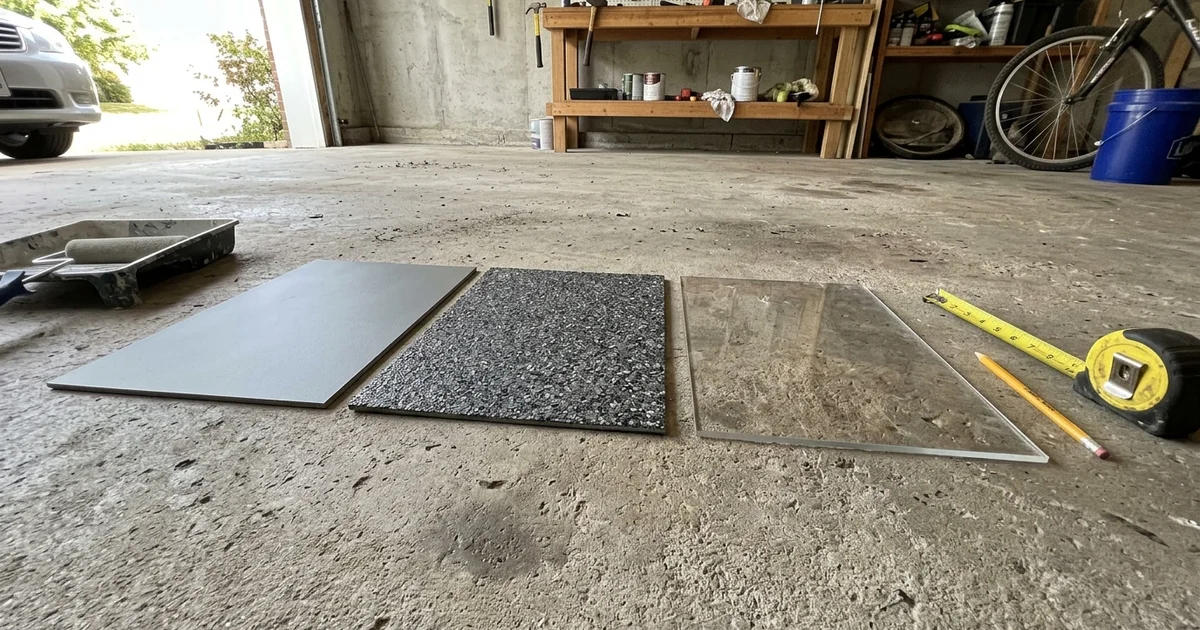
“Best” Depends on the Garage
We constantly explain to homeowners that the best garage floor coating depends entirely on how much abuse the space takes and the quality of the concrete preparation.
Many independent contractors simply push whatever product they carry, but a properly ground slab with a mid-range epoxy always outlasts a premium topcoat poured over a weak surface.
Our team has seen clear evidence that the way our garage floor epoxy systems are prepared matters far more than the topcoat. A standard 100% solids base applied to a properly diamond-ground slab easily beats an expensive polyaspartic poured over a weak, acid-etched surface.
Let’s look at the current market data, review the distinct systems available, and lay out exactly how to choose the right protection for your specific slab.
The Three Systems Worth Considering
We constantly remind clients that comparing garage floor coating options requires looking at the actual chemistry. Professional 100% solids epoxy, broadcast flake systems, and polyaspartic topcoats are the only three options genuinely worth your investment.
Water-based DIY kits from hardware stores like Home Depot often contain only 40% to 50% solids. Half of that mixture evaporates during curing, leaving a paper-thin film that peels under hot tires. Professional installations use entirely different materials to ensure permanence.
Solid-Color Epoxy
Our most affordable professional option is a pigmented, 100% solids epoxy base sealed with a clear topcoat. This chemistry cures thick, ensuring all the material stays on the floor for maximum durability.
Prices for professional epoxy installations across the US generally range from $3 to $7 per square foot in 2026. This finish looks clean and uniform, making it a staple in residential spaces.
Dust and tire scuffs do show up more easily on this smooth surface. It also highlights any minor slab imperfections that the initial grinding process did not completely remove.
Flake Broadcast Systems
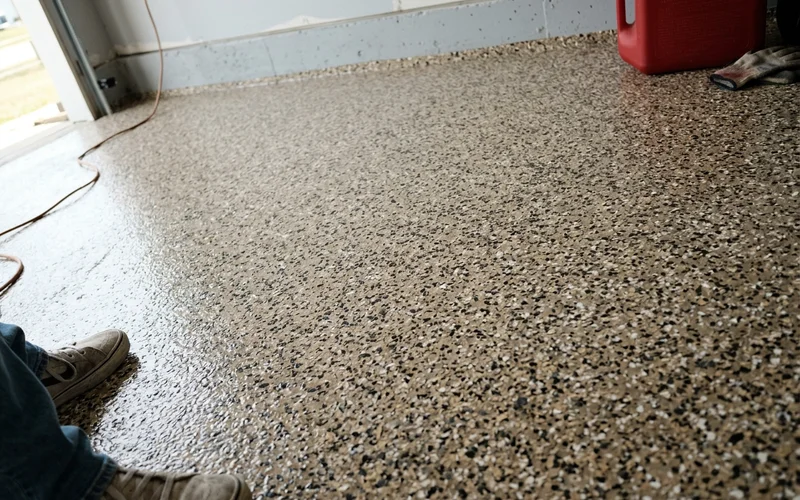
We install this multi-layer stack for the vast majority of homeowners. Installers pour the same 100% solids epoxy base, broadcast vinyl chips into the wet resin, and then seal everything under a clear topcoat.
The flake provides serious functional benefits. It completely hides minor concrete flaws and adds essential texture underfoot for wet days.
Our detailed guide to flake systems explained breaks down the various blends and broadcast densities. This layered approach creates a highly durable surface that handles typical suburban vehicle traffic with ease.
Polyaspartic and Polyurea Topcoats
Our highest-performing floors rely on polyaspartic technology for the top layer rather than the entire build. Polyaspartic cures in just 2 to 6 hours, allowing for rapid return-to-service.
These topcoats offer incredible UV stability, meaning they will not turn yellow near an open garage door. Upgrading to a polyaspartic finish pushes the US market installation cost closer to $5 to $12 per square foot. The premium price buys extreme flexibility in cold weather and a lifespan of 15 to 20 years, far outlasting standard 5 to 10 year epoxy limits.
The system beats the product
A reliable garage floor is a stacked system, not a single miracle liquid. You need a profiled concrete surface, a bonding primer, a thick 100% solids base, decorative flake, and a hard protective topcoat. Any product marketed as a one-coat permanent fix is hiding the truth.
What Durability Actually Depends On
We cannot stress enough that a floor’s long-term durability relies on mechanical concrete profiling, film thickness, and moisture management. Failures rarely happen because of bad resin, they happen because an installer skipped the essential diamond grinding or ignored high moisture levels.
Here are the actual metrics that dictate how long your floor will survive.
The Concrete Profile. Coatings do not act like glue, because they require physical peaks and valleys to grip. The International Concrete Repair Institute (ICRI) standardizes this roughness using the Concrete Surface Profile (CSP) scale.
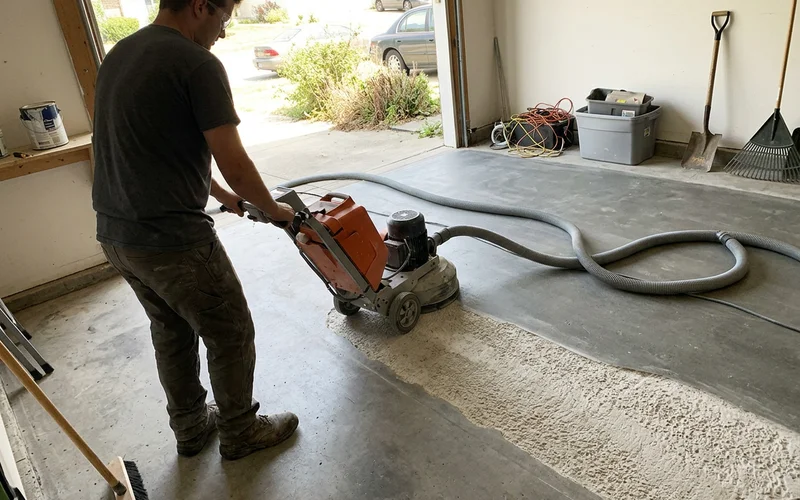
Our crews use heavy diamond grinders to achieve a CSP 2 or 3. This specific profile opens the pores of the slab and gives the resin a deep mechanical bond.
Film Thickness. Thicker applications directly translate to longer wear life. This metric is usually measured in mils.
While cheap water-based kits might leave 1 to 3 mils of thickness, a professional 100% solids epoxy easily builds to 10 or 20 mils. More cured material simply means more physical mass for hot tires and dropped tools to wear through.
Moisture Management. Trapped water vapor pushing up through the slab creates hydrostatic pressure that lifts any coating. We always recommend testing the moisture vapor transmission rate (MVTR) first. If a slab reads high for moisture in humid US regions, applying a specialized moisture-mitigating primer is the only reliable fix.
Topcoat Hardness. The clear topcoat takes all the physical abuse from heavy vehicles and chemical spills. A topcoat formulated with aliphatic polyurea or polyaspartic chemistry resists abrasion and automotive fluids far better than bare epoxy. This top layer keeps the colored base coat underneath looking completely untouched.
| Consideration | Solid color | Flake broadcast | Polyaspartic topcoat |
|---|---|---|---|
| US Cost Per Sq Ft | $3 to $7 | $4 to $9 | Adds $2 to $4 to system |
| Hides slab flaws | Poorly | Very well | N/A (clear) |
| Texture / grip | Smooth | Naturally textured | Depends on additive |
| Cure speed | 3 to 5 Days | 3 to 5 Days | 2 to 6 Hours |
| Lifespan Expectancy | 5 to 10 Years | 10 to 15 Years | 15 to 20+ Years |
| UV stability | Ambers over time | Ambers over time | Holds color |
What About Tiles and Roll-Out Mats?
We tell clients that interlocking garage tiles and roll-out mats are great temporary fixes, but they do not permanently seal or protect your concrete slab. High-quality modular floors hide damage well, but they trap mold-causing moisture underneath in humid US climates.
Interlocking Garage Tiles. Heavy-duty PVC or polypropylene squares from brands like Swisstrax and RaceDeck click together directly over the existing slab. These premium tiles cost between $3.99 and $7.75 per square foot in the US market.
Our customers love them because they install in an afternoon and hide terrible concrete without any grinding. High-end tiles can even support up to 60,000 pounds of rollover weight.
The major trade-off involves the seams. Water, dust, and automotive fluids easily drain underneath and stay trapped against the concrete.
On a damp slab, this trapped moisture quickly turns into a severe mold issue. Tiles also tend to shift slightly when dragging heavy toolboxes across the room.
Roll-Out Vinyl Mats. Products like G-Floor mats offer the absolute cheapest and fastest fix available. They provide genuine utility for a rented space or a temporary workshop setup.
The downside is that large mats trap ground moisture tightly against the concrete surface. The edges consistently curl up over time, creating a tripping hazard.
We remind clients that both modular options make sense if you rent your home or desperately need a reversible surface. Neither option actually seals the concrete, meaning a damaged slab will continue dusting and spalling underneath the plastic. If your primary goal is to permanently protect the concrete, a diamond-ground resin coating remains the only viable choice.
Matching the Finish to How You Use the Space
We base our final recommendation on your daily activity, typically pointing suburban homeowners toward a flake system with a polyaspartic topcoat for maximum vehicle protection. The right choice balances your need for slip resistance, impact durability, and easy maintenance.
- Daily Vehicle Parking: A full flake system with a polyaspartic topcoat serves as the ideal setup for standard residential use. The texture improves the coefficient of friction for wet shoes, while the topcoat repels harsh US winter road salts.
- Heavy-Duty Workshops: Impact resistance becomes the top priority when dropping tools and dragging steel. We suggest maximizing film thickness and utilizing a high-wear top layer rather than focusing on decorative elements.
- Show Garages: A metallic epoxy or a solid high-gloss finish delivers a stunning visual impact for car collections. Just note that a mirror-smooth finish demands frequent sweeping and mopping to maintain its appearance.
When reviewing contractor quotes, ignore the flashy brand names printed on the buckets. You should ask exactly how the crew plans to prep the concrete, what the solids percentage of the base layer is, and which specific chemistry makes up the topcoat.
When you evaluate epoxy vs flake vs polyaspartic floors, remember that the prep work and material thickness define the outcome. Our team provides free on-site inspections to test your concrete and answer these exact questions. Give us a call to find out exactly which specification your slab needs to last a lifetime.